Pick a stake
Use a size that fits the session limit. Changing stake also changes the saved Zeus progress context.
 GodPlay Plinko
Play Now
GodPlay Plinko
Play Now

Rules guide
Read the GodPlay Plinko board from controls to payout slots, then use the demo to practice risk, rows and bonus behavior without rushing.
Controls
GodPlay Plinko is easier to understand when the control strip is read before the board.
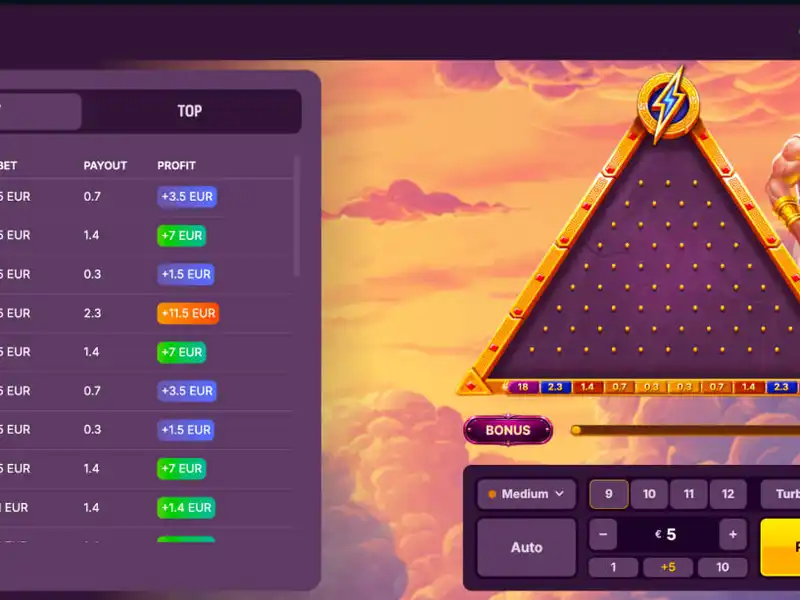
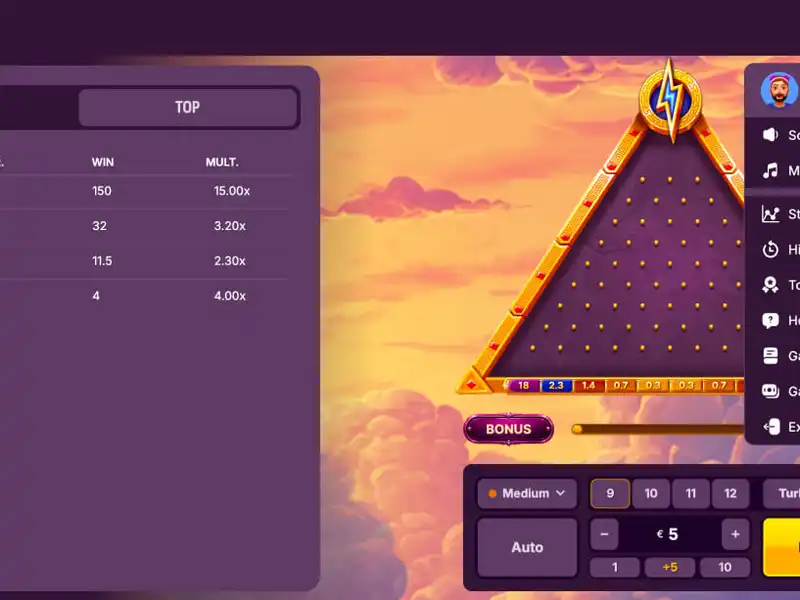
The main controls are Play, Auto, bet decrease and increase, suggested bet chips, risk selector, rows selector, sound, music, menu, Turbo and Bonus. The screenshots show a $1 stake with suggested chips such as +1, 5 and 10. Those values are interface examples, not a universal casino limit.
Before pressing Play, read the active risk level and row count. Those two settings shape the payout line before the ball falls. After pressing Play, the player does not steer the ball. The board resolves the drop and the final slot pays the shown multiplier.

Round flow
Use a size that fits the session limit. Changing stake also changes the saved Zeus progress context.
Low, Medium and High do not change the fact that the result is random. They change payout spread.
Rows add peg interactions and alter how the payout line is arranged.
The ball drops and the landing slot decides the multiplier.
Use history and statistics to read session pace, not to predict the next drop.
Paytable
A Medium risk 9-row screenshot shows a clear symmetric payout line.
| Board area | Visible example | Reading note |
|---|---|---|
| Edge slots | 18x and 18x | Higher value, lower hit frequency |
| Near edge | 2.3x and 1.4x | Meaningful returns outside the center |
| Shoulders | 0.7x | Partial return zones |
| Center | 0.3x and 0.3x | Lower payout landing area |
| Hades boosted example | 270x, 34.5x, 21x, 4.5x center | Boosts multiply selected slots during the bonus state |
Bonus rules
Regular paid bets fill the Zeus Progress Bar. When it reaches 100%, Zeus Bonus starts automatically and awards 15 free bonus balls. The progress bar is stored separately by bet amount, so a stake change matters.
Zeus buy costs 50x and Hades buy costs 100x. Bonus balls and purchased bonuses do not generate progress. During a bonus, the player cannot change bet, buy another bonus or build progress.
Player notes
Screens


FAQ
Choose a bet, set risk and rows, then press Play. The ball drops through the board and the landing slot decides the multiplier.
More rows add more peg interactions and usually widen the spread between center and edge payouts. Fewer rows make the board easier to read.
Low risk favors steadier center outcomes, Medium balances spread and payout, and High risk pushes more value toward edge slots.
No. Auto bet repeats the same action. It can speed up a session, so round caps and loss limits matter.
Turbo speeds up the animation and reveals the result sooner. It does not improve odds or reduce house edge.
No. The rule screens show that bonus balls and purchased bonuses do not generate Zeus progress.
The rules state that an active bet is played and any win is credited automatically if connection drops during the round.
Source notes
The how-to-play page should be read with two layers in mind. The first layer is visible on the screen: bet size, risk setting, row count, payout slots and feature buttons. The second layer sits in the rules: RTP, house edge, bonus restrictions and what happens when a connection drops. Keeping those layers separate prevents a player from treating a dramatic animation as proof of a better chance.
The VeliPlay page gives enough confirmed facts to build a useful guide, but it also shows one important conflict around RTP. This site uses 96% because that value appears in the official meta wording and feature grid. The conflicting 97% metric is still mentioned where relevant so readers see the source limit rather than a polished claim.
The most useful habit is to test one variable at a time. Change risk without changing rows, then change rows without changing risk. After that, compare Zeus and Hades in demo with the same bet size. This slower approach makes the board easier to understand because each change has a visible effect on payout shape or exposure.
Bonus buys deserve their own budget line. Zeus at 50x and Hades at 100x are not small side buttons when the base bet rises. They should be tested as separate events with their own stop point. A player who treats the buy button as a recovery tool is no longer reading the game clearly.
Auto bet and Turbo are convenience tools. They do not improve RTP, and they can make a session move faster than intended. A clear round cap matters more than the animation speed. If the board starts to feel automatic, stopping is the cleaner choice than changing risk to force a different result.
The game fits adults who like short rounds, clear multiplier slots and bonus states with a strong visual theme. It does not fit anyone looking for income, debt recovery, pressure play or a way around local gambling rules. Real-money play should start only after demo practice and account terms are understood.
A second useful pass is to compare the visible interface with the rule layer behind it. The board can make a result feel close or earned, but stake size, risk settings, feature rules and account terms decide what the player is really accepting.
The RTP conflict should stay visible instead of being polished away. When one official surface supports 96% and another metric suggests 97%, the conservative reading is to cite the safer value and explain the mismatch.
For practice, change only one setting per demo run. Keeping stake, risk, rows and bonus choice separated makes it easier to see which part changed exposure and which part was normal variance.
Bonus buys should be treated as separate high-exposure events. A 50x or 100x button can drain a session faster than normal drops, so it needs its own stop point rather than being used to recover losses.
Speed controls are convenience features only. They do not improve RTP, and they can hide how quickly decisions repeat, so round caps and pauses matter more than animation speed.
The best fit is an adult player using demo practice and clear limits. Anyone trying to recover losses, create income from gambling or bypass local rules should avoid real-money play.
For this page, a second useful pass is to compare the visible interface with the rule layer behind it. The board can make a result feel close or earned, but stake size, risk settings, feature rules and account terms decide what the player is really accepting.
For this page, the RTP conflict should stay visible instead of being polished away. When one official surface supports 96% and another metric suggests 97%, the conservative reading is to cite the safer value and explain the mismatch.
For this page, for practice, change only one setting per demo run. Keeping stake, risk, rows and bonus choice separated makes it easier to see which part changed exposure and which part was normal variance.
For this page, bonus buys should be treated as separate high-exposure events. A 50x or 100x button can drain a session faster than normal drops, so it needs its own stop point rather than being used to recover losses.
For this page, speed controls are convenience features only. They do not improve RTP, and they can hide how quickly decisions repeat, so round caps and pauses matter more than animation speed.
For this page, the best fit is an adult player using demo practice and clear limits. Anyone trying to recover losses, create income from gambling or bypass local rules should avoid real-money play.
In this page context, a second useful pass is to compare the visible interface with the rule layer behind it. The board can make a result feel close or earned, but stake size, risk settings, feature rules and account terms decide what the player is really accepting.
In this page context, the RTP conflict should stay visible instead of being polished away. When one official surface supports 96% and another metric suggests 97%, the conservative reading is to cite the safer value and explain the mismatch.
In this page context, for practice, change only one setting per demo run. Keeping stake, risk, rows and bonus choice separated makes it easier to see which part changed exposure and which part was normal variance.
In this page context, bonus buys should be treated as separate high-exposure events. A 50x or 100x button can drain a session faster than normal drops, so it needs its own stop point rather than being used to recover losses.
In this page context, speed controls are convenience features only. They do not improve RTP, and they can hide how quickly decisions repeat, so round caps and pauses matter more than animation speed.
In this page context, the best fit is an adult player using demo practice and clear limits. Anyone trying to recover losses, create income from gambling or bypass local rules should avoid real-money play.
For the reader here, a second useful pass is to compare the visible interface with the rule layer behind it. The board can make a result feel close or earned, but stake size, risk settings, feature rules and account terms decide what the player is really accepting.
For the reader here, the RTP conflict should stay visible instead of being polished away. When one official surface supports 96% and another metric suggests 97%, the conservative reading is to cite the safer value and explain the mismatch.
For the reader here, for practice, change only one setting per demo run. Keeping stake, risk, rows and bonus choice separated makes it easier to see which part changed exposure and which part was normal variance.
For the reader here, bonus buys should be treated as separate high-exposure events. A 50x or 100x button can drain a session faster than normal drops, so it needs its own stop point rather than being used to recover losses.
For the reader here, speed controls are convenience features only. They do not improve RTP, and they can hide how quickly decisions repeat, so round caps and pauses matter more than animation speed.
For the reader here, the best fit is an adult player using demo practice and clear limits. Anyone trying to recover losses, create income from gambling or bypass local rules should avoid real-money play.
On this specific page, a second useful pass is to compare the visible interface with the rule layer behind it. The board can make a result feel close or earned, but stake size, risk settings, feature rules and account terms decide what the player is really accepting.
On this specific page, the RTP conflict should stay visible instead of being polished away. When one official surface supports 96% and another metric suggests 97%, the conservative reading is to cite the safer value and explain the mismatch.
On this specific page, for practice, change only one setting per demo run. Keeping stake, risk, rows and bonus choice separated makes it easier to see which part changed exposure and which part was normal variance.